

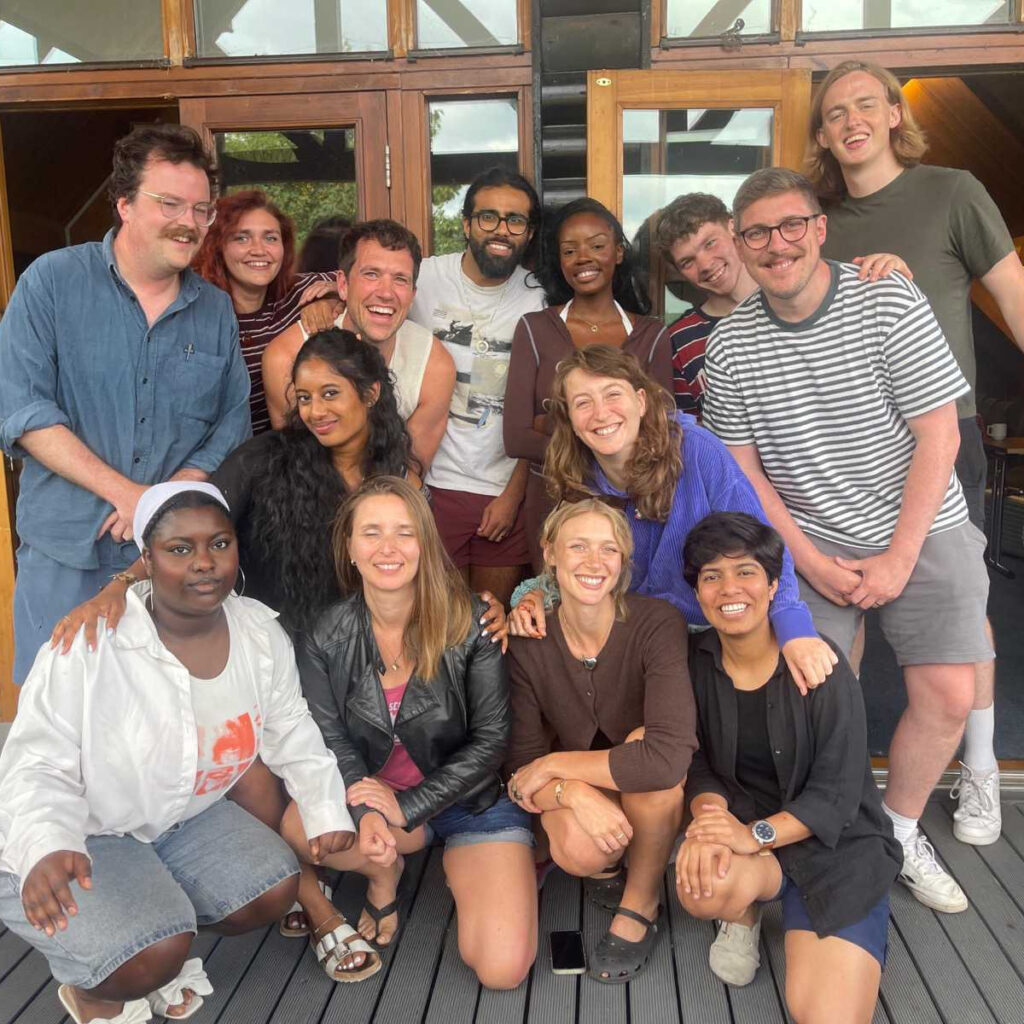
Meet Dami, a member of our New Economy Influencers Collective. In this impact story, she shares how the programme shaped her online content, helped her build a peer network, and deepened her understanding of economics. Supported by Rethinking Economics International, the Collective empowers UK influencers to challenge mainstream narratives and put forward new economic ideas online.
An introduction
When Dami showed up for her first New Economy Influencer session, economics wasn’t at the front of her mind. She was looking for a community of peers fighting the same fight online — and a space to build her confidence in bringing left-wing ideas into her content.
Dami is a TikToker, student and youth worker. She’d built up an impressive presence on social media, initially with music cover performances, social commentary and personal musings on being a young person. Her main following is young women, with her top post reaching a whopping 1.2 million views.
Things started to shift after a surprise hit with a political video. In November 2021, when then UK Home Secretary, Priti Patel, announced that the UK would proscribe Hamas making it illegal to show support for the Palestine based organisation, Dami felt moved to act. She filmed herself holding a Palestinian flag and posted it, uncertain of what the consequences might be. Since then she’s increasingly brought more politics into her content.
As for economics, that certainly wasn’t the main pull to her page.
One thing Dami is not; a trained economist. If you’d pressed her on how confident she’d have felt communicating about economics before the training she’d have said ‘no way, I can’t talk about economics. I’d get caught out’.
There were moments when she would have appreciated that confidence. She remembers when the UK government cut financial support for people living with disabilities. ‘I remember being really frustrated and wanting to talk about it. But I didn’t really know anything about government budgets …[and felt like I] couldn’t really speak on whether or not it was something that they needed to get rid of ’. She decided to drop the economics and focus her post on the negative effects of the cuts on the lives of disabled people.
What Dami already had was a voice, an audience and an instinct for talking about the political issues she cares about. Still, she missed having a network of people she could turn to when she wanted to explore her takes before posting and the confidence to land her political points with greater punch.
Finding her people
She joined the New Economy Influencers Collective to address that gap. The programme had been set up to launch a new UK community of influencers, supported by the Rethinking Economics International staff team, to brush up on their economic communication skills, challenge mainstream narratives and put forward new ideas online.
Building a relationship with one like-minded influencer was Dami’s modest training aim. She has friends who are left-leaning, and friends who are creators, but few who fit into both camps. What she wanted was a peer group that she could lean on when working on political content – and people who understand the pressures of putting views online and what it means to challenge the mainstream.
The training exceeded her expectations. Dami shared with a beaming smile, ‘I don’t warm to people easily, but every person on the trip was so lovely, even in the facilitators – I love them all.’ She left the training with strong ties, kept alive by three active WhatsApp groups, where the influencers share content ideas, published posts and opportunities for collaboration.
Making government responsibility stick
As she worked through the programme, Dami realised that she had more to say about economics than she had originally thought.
The turning point came when the trainer started talking about Margaret Thatcher. Of course Dami had heard of the no-sleep, egg-loving and intentionally gravel-voiced former UK Prime Minister. The way that Thatcher created a culture of cuts that justified her dismantling of the welfare state, leaving behind a deep-set idea that governments have little influence over cuts and that austerity is really something that is simply happening to them, was new to Dami. The message really hit home when the group played a role-play game exploring how the real economy functions and how it is shaped and practised is ultimately a political decision.
The new lens for thinking about the role of government in steering the economy made Dami reconsider something that she’d taken for granted. She’d never been shy about pointing out that the government is not doing enough to make sure that the economy serves everyone’s needs. But there was something making her pull her punches. She realised she’d been giving the government the benefit of the doubt, seeing its role as manager of the economy as a difficult one, believing they should be given some space to get it right. Now, she had a new way of looking at those choices, one that didn’t allow the government to abstain from responsibility.
The making of 21st Century Economists
This shift matters. Dami has new confidence and tools to question her own assumptions and decide for herself what she thinks about them. And she isn’t doing that alone. She has a collective to connect and coordinate with. That collective power is all the more important in the social media world that can make political action feel like the work of isolated individuals.
Dami’s already started putting her learning into practice. Shortly after the training she put her frustration around government cuts to support for disabled people into a new post. ‘’This time when I made the video, I knew there was zero excuse for them to pull the funding’’ Dami shared.
We need more stories like this because changing how economics is taught and practised needs more than arguments that are well made. We need people on all fronts who can question economic assumptions that have long gone unchallenged, and bring new ways of thinking about economics into the communities that already trust them.
Building our movement’s counter-power requires redefining who gets to lead and shape economic thinking. That leadership can take many forms: the student challenging the assumption behind their curriculum; the workplace organiser connecting their workers’ rights struggle to wider economic theory; the influencer introducing their audience to questions about who has power in the economy; or the community organiser highlighting how their community challenges economic orthodoxy by contributing to the care economy.
That’s why we’re supporting Dami and others like her to find their feet.
In the age of right-wing podcasters, the “manosphere” and a massive ecosystem bankrolled by conservative funders, powerful voices are shaping online and mainstream discourse in many countries. We need more Damis out there, pushing back against the trend.
Dami is one of 12 influencers who’ve already joined the collective, each bringing their own perspectives and voices to their followers. This month, we’re starting to bring even more influencers into the collective with a recruitment drive for the next cohort.
We don’t want to stop with influencers. We want to build a much bigger movement of people who can challenge the economic mainstream wherever it rears its head — be that in classrooms, workplaces, media or communities.
That’s the challenge for the next few years: to bring together people who believe that economics can work for both people and the planet, and give them the support they need to bring their ideas to the mainstream conversation. Click here to find out more about how we co-created our new strategy with the wider movement and our plans for the future.
Want to know more?
Watch Dami talk about her experiences with the New Economy Influencers Collective in our video.

Contributors
Laura Williams
Laura joined Rethinking Economics as Communications Lead in 2026. She first became involved with the movement while serving as Campaigns Officer at the University of University of Manchester Students’ Union. Frustrated by the limitations of mainstream economics in explaining an increasingly unstable world and addressing human needs, she was

Share this article
Topics

Sustained student pressure secures win at University of Copenhagen
The win The Department of Food and Resource Economics (IFRO) at the University of Copenhagen agrees to hire a new professor in Ecological Economics. Previously economics and the environment had largely been taught from a neoclassical perspective. The way there The Rethinking Economics IFRO team organised a […]
Wednesday 1 January 2025

Curriculum Reform Amid Security Crisis in Ecuador
The win Against a backdrop of escalating violence and political instability in the country, Rethinking Economics Ecuador successfully reshaped their university curriculum at Facultad de Ciencias Económicas at the University of Guayaquil to reflect pluralist and heterodox economic perspectives. The curriculum reform introduced concrete shifts […]
Wednesday 1 January 2025

Swiss group VWelles Bern runs Pluralist Economics lecture
The win In February, the Swiss local group VWelles Rethinking Economics Bern will kick off its first self-organised lecture series, “Introduction to Pluralist Economics”. The course will give an overview of the different schools of thought, after three introductory sessions on philosophy of science. Six […]
Monday 1 January 2024