
The win
Since 2021, the undergraduate students of the largest university in Mexico, la UNAM, are able to attend an inspiring elective course in feminist economics. Taught by professors Virginia García Sánchez and Deyanira Navarrete Paredes, their focus vary between feminist theory and its policy implications. Both versions have been praised for embracing a truly engaging and critical type of pedagogy, grounding the reflections in the classroom with the students’ lived experience – in the vein of critical feminist praxis. This reflects in enrollment success, with the course spots filling up fast every year.
The course always presented a rich local context, integrating the classical and the contemporary international others with the Mexican case and with the dynamics in economics. We also did a practical case for us, which we presented. We did one in writing, the group was really receptive. We were not only women by the way: there were a significant amount of other classmates, some of them men, some of them non binary. That was nice to have. The class itself was valuable because of that, and the interactions and the discussions we had.
As part of the wider movement that took hold of this renowned institution throughout 2019 and 2020, other important changes were implemented: allegations of sexual harassment from professors were followed through and acted upon; and teaching staff at the university now receive training against inappropriate sexist conduct. The culture at UNAM has therefore changed from a place where sexual harassment was tolerated and denounced only anonymously, to an institution where such predatory behaviour can be publicly criticised and that the university now takes more seriously. This cultural change is particularly welcome for women and transgender students in economics programmes which are largely cismale-dominated (both in the teaching staff and the student cohort).
The way there
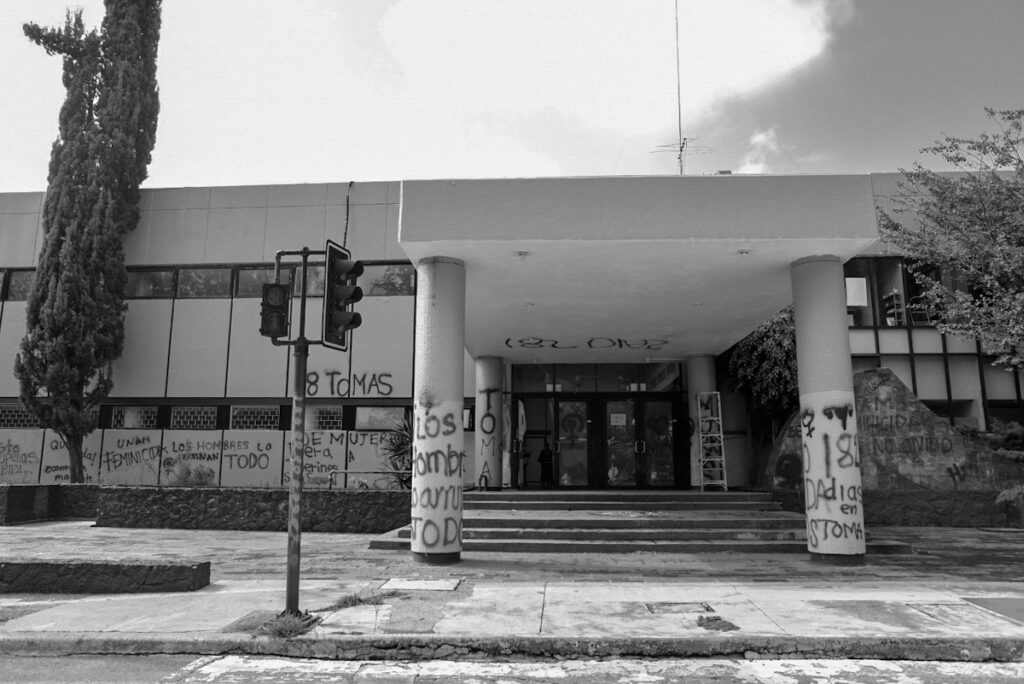
In 2019, Mexico City came to a loud standstill through the Glitter Revolution (Revolución diamantina): thousands and thousands took to the streets to protest against gender violence, in a context of increasing feminicides. In the vein of the powerful feminist actions taking place in the whole South American continent, Mexico’s feminist uprising spread through the nation and reached the university in a few months. By March 2020, the movement was organised enough to deliver clear demands at UNAM. The organic collective of protesting students published a list of 32 demands, most of them measures against the different shapes of gender violence taking place at UNAM and the institution’s complacency towards it.
As the decision-makers ignored the pressure created by the protests, the pro-feminist students switched to another effective campaigning tactic: occupation. They set up camp at the Economics Faculty for what was to be a long battle of six months! The self-procclaimed Organised Women of the Faculty of Economics (las Mujeres Organizadas de la Facultad de Economía) started the suspension of activities in March 2020 – precisely when the global pandemic of Covid 19 was leading to its first lockdowns. They remained on campus until September, despite difficulty of access to food, hygiene, and the health insecurity caused by the pandemic outbreak.
The negotiation was a very long process. Form the start of the demand, march 2020, until the curriculum change was almost 1.5 years, 2 years, with many ups and demands. Every table was pretty long hours, 6 hours, 4 hours. Each time the results weren’t satisfactory! Because the dean says one thing, committed to it, and then didn’t do that. So it was the strategy to exhaust physically and mentally the community, which eventually didn’t happen. That’s why it took so long.
By the end of the occupation, the university accepted and implemented 27 of the 32 demands – including a new curricular offer in feminist economics!
Factors of success
- Mass national mobilisation – a feminist zeitgeist
- Organic growth of the movement, around an issue widely and deeply felt
- Practical support from allies (professors and other students), purchasing food and items for the occupation
Learnings
- Importance of having a strong base and popular support, to not let your opponents undermine your cause
- Fighting the social isolation of the pandemic was challenging. For those with health safety concerns, keeping in touch and motivated through chat and messaging was already very helpful
- Building a reliable network of active allies was necessary to share the workload of supporting day-to-day needs around food and hygiene
More
- About the changes in the economics department [Spanish]
- About the occupation and protests at UNAM [Spanish]
- About Mexico’s 2019 Glitter Revolution [English]

‘I can’t talk about economics. I’d get caught out’
In this impact story, Dami shares how the New Economy Influencers programme shaped her online content, helped her build a peer network, and deepened her understanding of economics.
Thursday 15 October 2026

Sustained student pressure secures win at University of Copenhagen
The win The Department of Food and Resource Economics (IFRO) at the University of Copenhagen agrees to hire a new professor in Ecological Economics. Previously economics and the environment had largely been taught from a neoclassical perspective. The way there The Rethinking Economics IFRO team organised a […]
Wednesday 1 January 2025

Curriculum Reform Amid Security Crisis in Ecuador
The win Against a backdrop of escalating violence and political instability in the country, Rethinking Economics Ecuador successfully reshaped their university curriculum at Facultad de Ciencias Económicas at the University of Guayaquil to reflect pluralist and heterodox economic perspectives. The curriculum reform introduced concrete shifts […]
Wednesday 1 January 2025