


The facade is crumbling; patterns remain
The Hegemonster is slowly losing his game
In his tight attempt to contain control
Annihilating life, so that capital can flow
Doubling down with more of the same
A paranoia of power, clinging terrain
Bombing for peace; what a manic mantra
A deadly, destructive, demonic propaganda
that more and more people cease to believe
Sayin’: the monolithic myth is an outdated narrative.
Last year I learnt that symbiosis, the natural concept where two individual parts together are able to do something they couldn’t do by themselves, often occurs in times and tides of crisis. A classic example is when rising oxygen levels threatened life on Earth, about two billion years ago; an ancestral cell met an oxygen-loving bacterium and kept it as a partner instead of consuming it. This symbiotic relationship created mitochondria, the powerhouse of complex cells, and reshaped life as we know it.
Knowing that connection and collaboration can spark survival and new beginnings, I am left wondering: how much more dire must the conditions of life on Earth become before established economists recognise the value of pluralising their theoretic field?
The time is overripe for some academic symbiosis in the field of economics.
The mainstream monolith of monocropping mentalities
In the aftermath of the 2008 economic crisis, we saw a rise in students protesting for a renewal of the economic discipline, raising the point that “It’s not only the world economy that is in crisis – the teaching of economics is too, and this crisis has consequences far beyond the university walls.”
What students of economics are taught shapes the minds of the next generation of policymakers and, consequently, the societies we live in. Today we observe how a monoculture of economic theories results in a society with less critical thinking and poorer imaginaries. This narrow focus is depleting our ability to build resilience in the face of challenges.
In economics, the dominance of neoclassical theory is apparent in the fact that about 86% of economics teaching is concentrated on this theory. Neoclassical economics holds monopoly control over the economics narrative, leading it to suffer from what Sophie Strand refers to as a “narrative dysbiosis” in the ‘theoretical gut’ – suppressing a biodiversity of (economic) perspectives. Students are often not even told about the many other existing theories – such as institutional, feminist or Marxist economics.
Instead, they are served a grey theoretical platter, which is one of the reasons why many students of economics suffer from what I call academic dissonance: the uncomfortable feeling when learning that the models you are studying do not sufficiently reflect reality. Some of the reasons for that are that neoclassical theory lacks a proper analysis of power and overlooks the importance of energy. Furthermore, its fixation on efficiency and market-based solutions leads economists to yield recommendations that “become little more than a license for plunder”. Those words are not mine, by the way; they come from the Nobel Laureate Angus Deaton.
The servant of the Hegemonster
As often criticised, the theory holds a rather poor picture of human beings through its egocentric, always rational-minded and money-fixated protagonist Homo Economicus. This man shares similarities with the colonial settlers, as they both “see [themselves] as holding dominion over the earth and its flora and fauna” and have a worldview “where the wild land and wild people were made for” their benefit (Tuck & Yang, 2012).
I therefore look at neoclassical theory as a servant to the growth-based neoliberal capitalist hegemony, by Sahana Chattopadhyay called the Hegemonster. The system that upholds an (invisible) ”narrative predicated on expropriation, extraction, and exploitation coupled with genocide, ecocide, and epistemicide”, leading us towards planetary collapse.
The Hegemonster and its servant(s) represent “the ultimate manifestation of a worldview founded on separation: seeing individuals as separate from others around them and humans as separate from the rest of life on earth”, as Jeremy Lent puts it (Klomp et al., 2021). One of the many threads in the pluriverse is to break us free from the neoclassical, free-market economic delusion (Kothari et al., 2019). Pluralising the field is a way of moving from “ego to eco” – shifting from an economy centred around dead capital and isolated individuals to one centred around life and relations.
From ego to eco
On our way there, we need to break the ego of neoclassical economics, and one way is to flow a biodiversity of stories and thinking that broadens our understanding of the world and sees humans not only as consumers but as interbeings – actors that act in common to their environment and living beings.
This is an embedded part of the pluriverse, a concept said to be first introduced by the Zapatistas in their decolonial struggle against the Hegemonster. It involves recognising the interconnectedness of economic, social, and environmental systems and embracing a diversity of perspectives that reflect this complexity. This relates to theoretical pluralism, which rests on the basic idea that if you want to understand anything, you should know it from various angles: if you have a microscope, you can see the bacteria and the microbiomes very well, but you can’t see the birds in the sky.
Academic symbiosis
The pluriverse aligns with the cosmological dimensions of ecology (Mbembe, 2023). Where mainstream economics is largely static and isolated, ecosystems are interconnected and dynamic. Building on ecological wisdom, a symbiotic relationship between different schools of thought can foster innovation and resilience as we combine the strengths of various approaches to address complex problems. Just imagine what a theoretical powerhouse we could construct, if neoclassical economics could consider the other theories as a partner, instead of arrogantly dismissing their value.
The deep history of the planet tells us that evolution is inherently relational. Species survival depends on our ability to weave ourselves into the fabric of life, to honour the relationships that sustain us. In contrast to what neoclassical theory models, nothing exists in isolation.
We do not need to “reinvent the wheel again”, as there already exists a range of alternative ways of understanding the economy. In African cosmologies, economy and ecology are synonymous (Mbembe, 2023). These and other perspectives are imperative to include in our ‘pool of knowledge’ on our way towards a post-development and -colonial society.
Colonisation, like capitalism, gives a ‘fait accompli’ (Said, 1978), preventing us from seeing possible solutions that form a fake reality we are expected to accept and live along with. But now that our scrolling screens smell of humans burnt alive, many people cannot ‘not see’ it anymore – the poisoned water we swim in. We are dragged out of the fait accompli that sleeps in bed with the neoliberal mantra of “There Are No Alternatives”, and the false impression that neoclassical theory serves us a theoretical “silver bullet”.
Maybe that is one of the lights that is shining through the many cracks: that people are recognising that the Hegemonster must be faced with bold action and a multitude of narratives that break up old patterns. A transformation of the monotonous field of economic thoughts into one ‘where many thoughts fit’ is one of the things leading us to the much-needed break-up.
Remember how the story of life on Earth teaches us that connection and collaboration are the keys to survival and new beginnings.
In the end, pluralising economics and realising the pluriverse means seeking a reorientation that includes transforming minds and our hearts. May the ashes of an outbombed Gaza be the tipping point where also the mainstream economists choose a path that embraces everyone and everything, “seeking to swelter generous materiality of care”, as Bayo Akomolafe puts it.
‘Cause caring systems catalyse care and can make the uncaring ones obsolete.
References and inspirations:
Tuck, E., & Yang, K. W. (2012). Decolonization is not a metaphor. Decolonization: Indigeneity, Education & Society, 1(1), 1-40.
Mbembe, A. (2023). Pathways of Tomorrow: Contribution to Thinking Commensurate with the Planet. Unesco.
Said, E. W. (1978). Orientalism. New York: Pantheon Books.
Klomp, R., Groeneveld, K., & van Dam, E. (2021). Thrive: Fundamentals for a New Economy. Thrive Publications.
Sahana Chattopadhyay
Nora Bateson and her concept of :
The facade is crumbling, patterns remain
The Hegemonster is slowly losing his game
In his tight attempt to contain control
Annihilating life, so that capital can flow
Doubling down with of more of the same
A paranoia of power, clinging terrain
Bombing for peace; what a maniac mantra
A deadly, destructive, demonic propaganda
that more and more people cease to believe
Sayin’: the monolithic myth is an outdated narrative
Where laws are in the claws of the hegemonic boss
Plurality is here to make it dissolve
‘Cause a robust economy should yield diversity
Like a thriving forest, that the Monster calls “prosperity“
when it’s propped and processed into non-living paper
Forgetting that humans we are also ‘nature’!
Photo by Noah Smith on Unsplash.
Contributors
Anna Nordahl Carlsen
Weaver, Rethinking Economics Norway

Share this article
Topics
Measuring What Matters: Inclusive and Sustainable Growth Beyond GDP
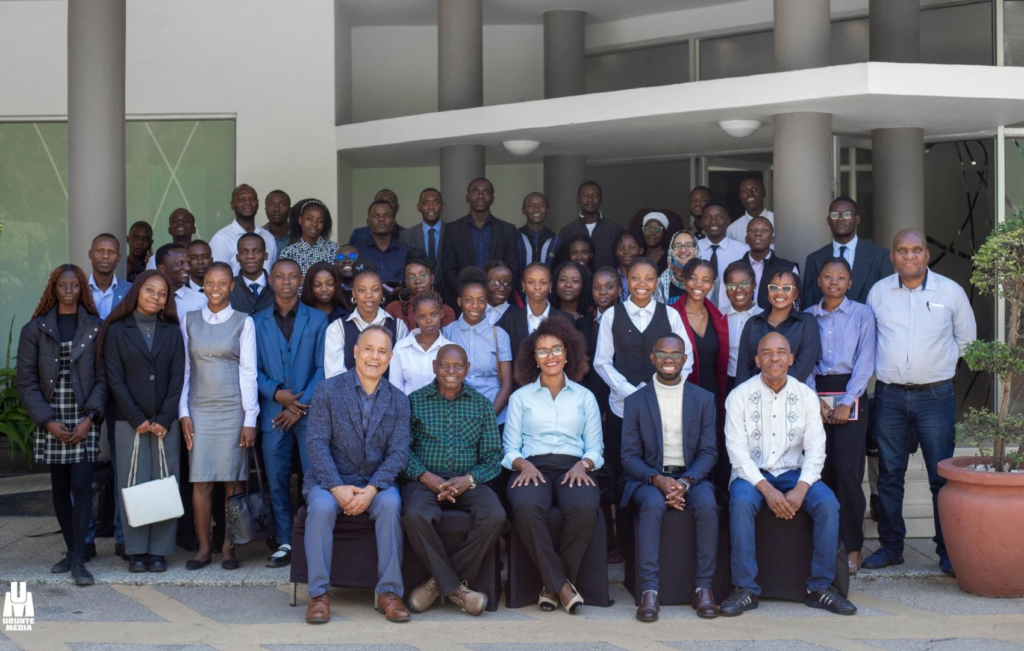
Participants came from public and private Universities, think-tanks, and research institutions namely Mulungushi University (MU), the Copperbelt University (CBU), Kwame Nkrumah University (NKU), ZCAS University, Information and Communication University (ICU), Cavendish University Zambia (CUZ), the University of Zambia, Kabwe Institute Of Technology (KIT), Amin Centre for Policy Research, and United Nations Zambia Youth.
Wednesday 7 October 2026

A trillion dollars is not a market signal. It’s a policy choice, repeated for twenty years.
We keep talking about Elon Musk’s wealth as if it fell out of the sky. It didn’t. It was built, piece by piece, by decisions that specific institutions made and could have made differently. If we want to understand extreme wealth concentration, we shouldn’t start […]
Monday 10 August 2026

Time as a Battleground in Brazil: Reflections from the III Desajuste Congress on Work in the Twenty-first Century
Recent reports from international organisations and economic news outlets suggest that Brazil is experiencing a period of sustained economic growth. Unemployment has fallen to historically low levels, GDP is expanding faster than expected, the Brazilian real has strengthened, and inflation remains under control. Yet, after […]
Monday 27 July 2026