

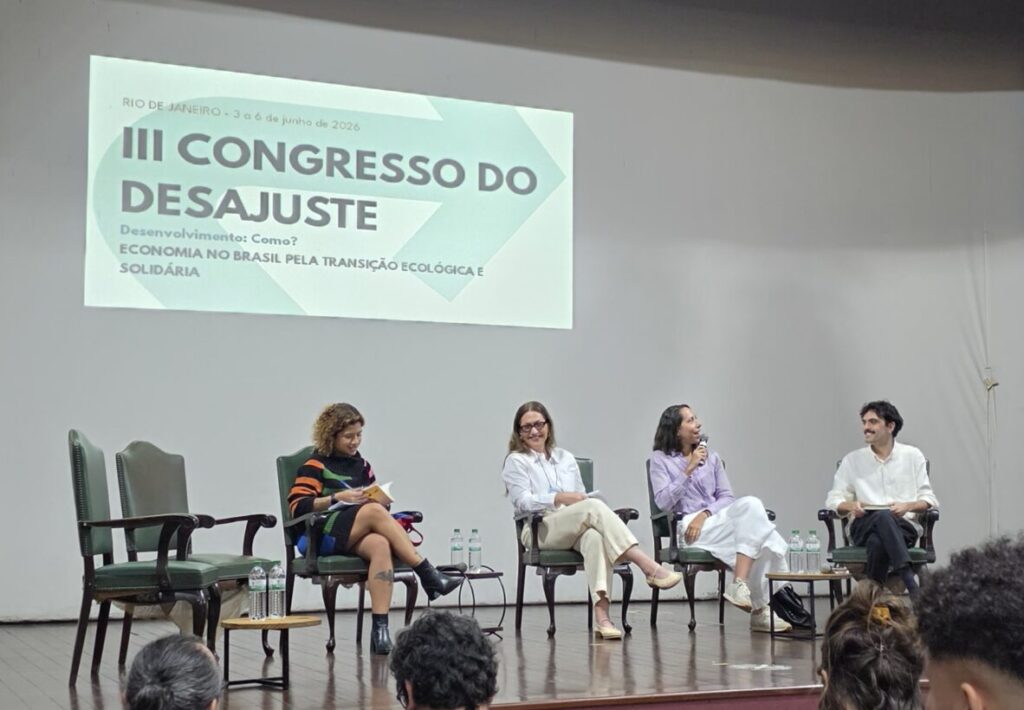
Recent reports from international organisations and economic news outlets suggest that Brazil is experiencing a period of sustained economic growth. Unemployment has fallen to historically low levels, GDP is expanding faster than expected, the Brazilian real has strengthened, and inflation remains under control. Yet, after immersing myself in the discussions at the III Desajuste Congress, organised by the Desajuste Fora da Curva network, it became clear that these encouraging macroeconomic indicators conceal a profound paradox in the lived experience of Brazilian workers.
Desajuste is a member of Rethinking Economics which brings together more than 500 students and economics professionals from across Brazil committed to a critical and plural approach to economics. The III Desajuste Congress met in Rio in early June.
The Six-day Workweek: A Debate About Time
At the heart of the discussions was the campaign to end Brazil’s six-day work week. More than a debate about labour legislation, it became a debate about time itself.
Recent legislation promoted by President Lula, and agreed by the lower house of Brazilian Congress after some negotiation, would bring an end to the six-day work week but it still requires passage through the Brazilian Senate.
Whilst discussions around the four-day work week in other countries often focus on productivity gains and business efficiency, the Brazilian debate begins from a different place. Rather than asking how workers can become more productive, it asks how much of people’s lives work should be allowed to consume.
Marilane Teixeira, a researcher at CESIT at Unicamp, described the movement as an act of boldness. Unlike the labour struggles of the 1980s and 1990s, when reducing working hours was seen primarily as a way to combat unemployment, today’s struggle is about reclaiming time for life. It responds to a reality in which around 550,000 Brazilians each year take leave from work because of mental health conditions linked to exhaustion.
Yet the discussions also revealed an uncomfortable paradox. Many workers support ending the six-day work week not because they expect to rest, but because they hope to use the extra day to take on bicos (side gigs) to supplement incomes that no longer cover the cost of living.
From the Dream of Formal Employment to the Meme of Failure
Brazil’s formal labour market has undergone a remarkable transformation.
Economist Sandra Brandão, who has extensive experience within the Brazilian government, observed that only fifteen years ago securing formal employment (carteira assinada) under the CLT, Brazil’s formal labour code, represented stability, dignity and upward social mobility. It was a milestone that families celebrated.
Today, however, formal employment under the CLT is frequently portrayed on social media as a symbol of failure.
Introduced under President Michel Temer in 2017, the labour reforms expanded outsourcing, increased contractual flexibility and encouraged new forms of self-employment in the name of making Brazil’s labour market flexible.
Instead, these reforms have elevated the image of the “exclusive self-employed worker”, encouraging people to see themselves as entrepreneurs even when their work remains highly dependent and tightly controlled.
For Marilane Teixeira, this transformation reflects a broader neoliberal project that individualises labour relations by weakening collective worker protections and shifting responsibility from employers to workers themselves. Social media and digital platforms reinforce this narrative, encouraging ride-hailing drivers and delivery workers to see themselves as independent businesses, even though algorithms increasingly determine how they work, when they work and how much they earn.
The State as Guarantor
For many speakers, reversing these trends requires fundamentally rethinking the role of the Brazilian state.
Marilane Teixeira argued that the state should act as a guarantor of employment in sectors essential to sustaining life, including healthcare, ecology, food sovereignty and the care economy. She suggested that a National Care Policy alone could create 11 million decent jobs over the next decade.
Achieving this vision, however, requires confronting what Sandra Brandão described as “the mother of all battles”: the public budget.
Brazil’s tax expenditures are estimated at R$544.5 billion in 2025, more than three times the budget of Bolsa Família, Brazil’s largest cash transfer programme for low-income families, whilst investment in workers’ social protection remains insufficient. According to Brazil’s Federal Court of Accounts (TCU), many of these tax expenditures disproportionately benefit higher-income taxpayers and large corporations, highlighting how public budgets reflect political choices about who receives state support.
Rebuilding a Sense of Belonging
One of the most thought-provoking moments of the congress came through a discussion of Peões, Eduardo Coutinho’s documentary about Brazilian metalworkers. A scene recalled by the speakers stayed with me: a worker proudly points to a lorry and tells his son, “I made that.”
Today, that sense of collective identity has become increasingly fragmented. Within the same workplace, independent contractors, agency workers, employees outsourced from partner companies, part-time staff and interns often work side by side yet rarely recognise themselves as belonging to the same working class.
As employment relationships have become more fragmented, so too has workers’ sense of belonging. Drawing on Karl Marx and Walter Benjamin, the discussion challenged the idea that artificial intelligence inevitably threatens human work. Technology is not destiny. It ultimately serves those who design it, own it and decide how it is used.
The challenge for the twenty-first century, therefore, is to rebuild solidarity and collective belonging, ensuring that technology eases people’s burdens rather than deepening exclusion.
Conclusion: A New Horizon
Leaving the Desajuste Congress, I was left with the sense that the debate around the six-day work week is about far more than working hours. It is about questioning the growing commodification of life itself.
As Marilane Teixeira reminded us, class struggle today takes place not only in production but also in social reproduction. Better wages alone cannot guarantee well-being if those earnings are immediately absorbed by private healthcare and education, services that the state should be providing.
The challenge, therefore, goes beyond the six-day work week itself. More time away from work must be accompanied by a system of social protection that does not depend solely on formal employment but instead safeguards people’s quality of life.
Perhaps the real desajuste (misalignment), lies in the growing gap between economic success and human well-being. Only then will Brazil move beyond celebrating impressive economic statistics whilst its workers continue to pay the price through physical and mental exhaustion. Only then can it become, in Sandra Brandão’s words, a society that is “able to be happy and believe that the future can be better.”


A trillion dollars is not a market signal. It’s a policy choice, repeated for twenty years.
We keep talking about Elon Musk’s wealth as if it fell out of the sky. It didn’t. It was built, piece by piece, by decisions that specific institutions made and could have made differently. If we want to understand extreme wealth concentration, we shouldn’t start […]
Monday 10 August 2026

Pathway to the Pluriverse: breaking the servant of the Hegemonster
The facade is crumbling; patterns remain, The Hegemonster is slowly losing his game…
Thursday 5 June 2025
Measuring What Matters: Inclusive and Sustainable Growth Beyond GDP
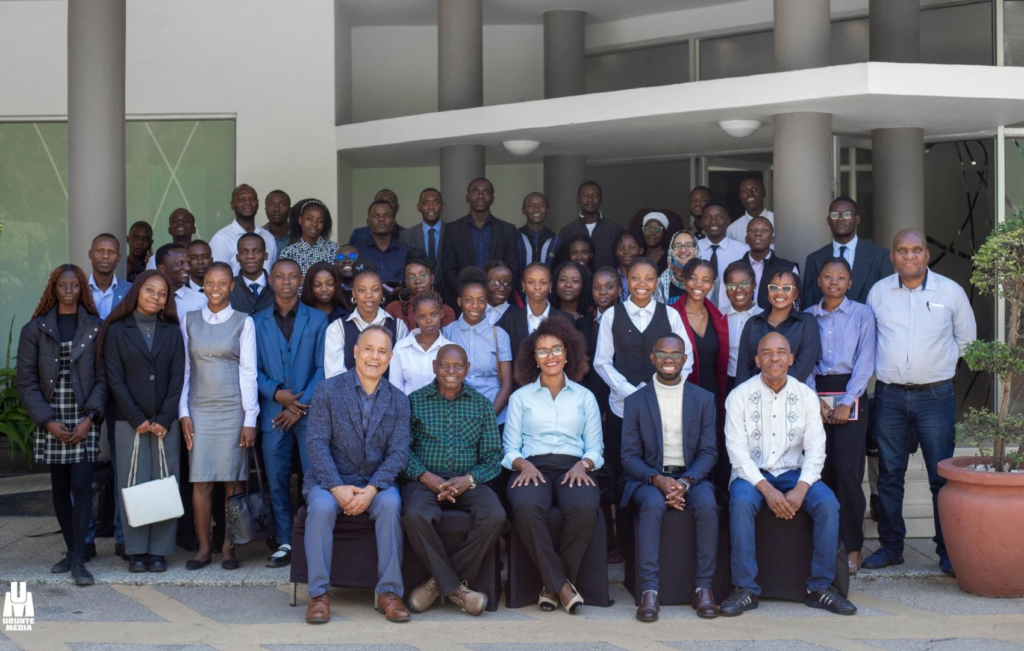
Participants came from public and private Universities, think-tanks, and research institutions namely Mulungushi University (MU), the Copperbelt University (CBU), Kwame Nkrumah University (NKU), ZCAS University, Information and Communication University (ICU), Cavendish University Zambia (CUZ), the University of Zambia, Kabwe Institute Of Technology (KIT), Amin Centre for Policy Research, and United Nations Zambia Youth.
Wednesday 7 October 2026